preloader

Enterprise Release &
Environment Management

Decouple the act of deploying code from the business act of releasing a feature. SNWN Tech Solution engineers advanced release orchestration strategies and dynamic environment management systems. We empower product teams to test features safely in production, eliminate staging bottlenecks, and rollback instantly if metrics degrade ensuring flawless user experiences and continuous business agility.

01

Safer Release Strategies

Use blue-green and canary deployments to manage change.

02

On-Demand Environments

Create preview spaces for testing and review.

03

Release Controls & Rollback

Monitor changes and respond quickly when issues arise.

Delivery challenges

The Release Reality: Legacy Bottlenecks vs. SNWN Orchestration

Engineering teams move faster when their delivery process is visible, repeatable, and easy to improve.

Business growth
Fragmented systems
Operational strain
Pressure point 01

The "Staging" Bottleneck

50+ developers blocked waiting to test code on a single, fragile, shared staging environment subject to frequent drift.

Operational impact
This makes changes harder to review and repeat across teams.
How SNWN responds
Ephemeral PR Preview Environments: Every code commit generates an isolated, containerized replica environment populated with anonymized mock data.
Pressure point 02

All-or-Nothing Launches

Deploying new software updates to 100% of user traffic simultaneously, risking widespread system outages and brand damage.

Operational impact
The extra handoffs can delay releases and make ownership unclear.
How SNWN responds
Canary Releases & Traffic Shadowing: Gradually shift 1% to 5% of production traffic to new builds while shadowing live requests to evaluate performance safety.
Pressure point 03

High-Risk Rollbacks

Engineers scrambling during production incidents to manually revert database migrations and redeploy legacy artifacts.

Operational impact
Teams may spend time fixing avoidable differences between environments.
How SNWN responds
Blue/Green Deployments: Maintain identical idle green environments for zero-downtime cutovers and single-click, instant traffic reversals.
Pressure point 04

Code Freeze Lockouts

Halting all engineering velocity for weeks to stabilize releases before major marketing announcements or product launches.

Operational impact
Without useful feedback, reliability problems can be harder to catch early.
How SNWN responds
Dark Launches & Feature Flags: Continuously merge production code behind inactive feature flags, granting business teams instant runtime toggle control.

Engineering capability map

Core Release Management Capabilities

Connect the right engineering practices, automation, and platform tools to the way your teams deliver software.

PlanScope and approvals
PackageVersioned artifacts
PromoteEnvironment controls
ObserveHealth and rollback
Capability 01

Advanced Deployment Strategies & Traffic Routing

Implement Argo Rollouts and Istio service mesh controllers to orchestrate dynamic Blue/Green and Canary deployments with progressive traffic shifting.

Practical deliverables

  • Implement Argo Rollouts and Istio service mesh controllers to orchestrate dynamic Blue/Green and Canary deployments with progressive traffic shifting.
Capability 02

Ephemeral (On-Demand) Preview Environments

Spin up automated, containerized preview environments for every pull request, enabling isolated feature validation and immediate teardown upon merging.

Practical deliverables

  • Spin up automated, containerized preview environments for every pull request, enabling isolated feature validation and immediate teardown upon merging.
Capability 03

Feature Flagging, Dark Launches & Targeted Delivery

Integrate enterprise feature management tools to decouple deployments from releases, allowing targeted cohort rollouts and risk-free production dark launches.

Practical deliverables

  • Integrate enterprise feature management tools to decouple deployments from releases, allowing targeted cohort rollouts and risk-free production dark launches.
Capability 04

Automated Release Orchestration & Governance

Establish automated release gates that validate API contracts, execute integration tests, and coordinate multi-service deployments across complex microservice architectures.

Practical deliverables

  • Establish automated release gates that validate API contracts, execute integration tests, and coordinate multi-service deployments across complex microservice architectures.
Capability 05

Closed-Loop Telemetry & Automated Auto-Remediation

Connect deployment controllers to APM telemetry to trigger instant automated rollbacks whenever error rates or latency thresholds are breached.

Practical deliverables

  • Connect deployment controllers to APM telemetry to trigger instant automated rollbacks whenever error rates or latency thresholds are breached.

Applied engineering workflows

Practical Enterprise Release & Environment Management Use Cases

See how platform engineering improvements can reduce friction in the everyday work of building and operating software.
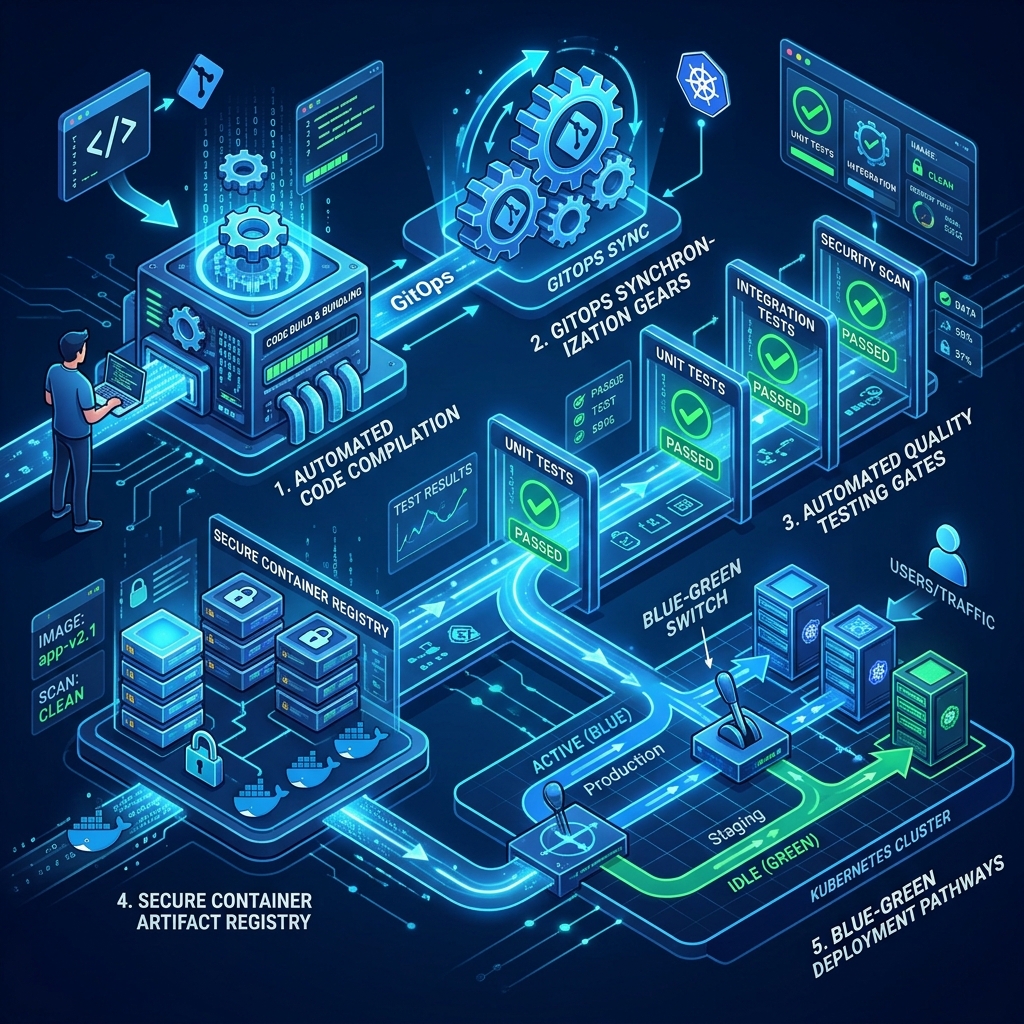
Core Release & Environment Management Capabilities - SNWN Tech Solution
Built around your sectorEngineering For,
Enterprise Release & Environment Management

Select a use case to view its scenario, outcome and delivery steps.

Use Case 01

Zero-Downtime Deployments

Related: DevOps Consulting →

Execute seamless Blue/Green and Canary traffic shifts using intelligent routing without dropping active user sessions, losing transactions, or spiking latency.

OutcomeExecute seamless Blue/Green and Canary traffic shifts using intelligent routing without dropping active user sessions, losing transactions, or spiking latency.
  1. Review

    50+ developers blocked waiting to test code on a single, fragile, shared staging environment subject to frequent drift.

  2. Design

    Implement Argo Rollouts and Istio service mesh controllers to orchestrate dynamic Blue/Green and Canary deployments with progressive traffic shifting.

  3. Automate

    Execute seamless Blue/Green and Canary traffic shifts using intelligent routing without dropping active user sessions, losing transactions, or spiking latency.

  4. Improve

    Assessing pipeline bottlenecks, architecture readiness, telemetry coverage, and current deployment incident metrics.

Use Case 02

Instant Automated Rollbacks

Related: CI/CD Automation →

Trigger automated sub-ten-second rollbacks powered by real-time APM telemetry tracking elevated error rates, HTTP 5xx surges, and degraded service latency.

OutcomeTrigger automated sub-ten-second rollbacks powered by real-time APM telemetry tracking elevated error rates, HTTP 5xx surges, and degraded service latency.
  1. Review

    Deploying new software updates to 100% of user traffic simultaneously, risking widespread system outages and brand damage.

  2. Design

    Spin up automated, containerized preview environments for every pull request, enabling isolated feature validation and immediate teardown upon merging.

  3. Automate

    Trigger automated sub-ten-second rollbacks powered by real-time APM telemetry tracking elevated error rates, HTTP 5xx surges, and degraded service latency.

  4. Improve

    Developing Infrastructure as Code (IaC) modules and containerized runners to enable dynamic preview creation.

Use Case 03

Infinite Ephemeral Staging

Related: Infrastructure as Code →

Spin up on-demand, containerized preview environments automatically for every pull request, and instantly tear them down upon branch merge.

OutcomeSpin up on-demand, containerized preview environments automatically for every pull request, and instantly tear them down upon branch merge.
  1. Review

    Engineers scrambling during production incidents to manually revert database migrations and redeploy legacy artifacts.

  2. Design

    Integrate enterprise feature management tools to decouple deployments from releases, allowing targeted cohort rollouts and risk-free production dark launches.

  3. Automate

    Spin up on-demand, containerized preview environments automatically for every pull request, and instantly tear them down upon branch merge.

  4. Improve

    Configuring service meshes and ingress controllers for weighted traffic shifting and canary analysis.

Delivery approach

How We Deliver Enterprise Release & Environment Management Projects

We work in clear stages, validate changes with your team, and prepare the workflow for ongoing ownership.

Select a step to explore its activities, buyer inputs and outputs.

  1. Step 01

    Release & Deployment Audit

    Assessing pipeline bottlenecks, architecture readiness, telemetry coverage, and current deployment incident metrics.

    Engineering Activities

    • Assessing pipeline bottlenecks, architecture readiness, telemetry coverage, and current deployment incident metrics.

    Buyer Inputs

    • Share relevant repositories, environments, access, and team ownership for this stage.

    Concrete Outputs

    • Documented results and agreed next actions for release & deployment audit.
  2. Step 02

    Ephemeral Environment Automation

    Developing Infrastructure as Code (IaC) modules and containerized runners to enable dynamic preview creation.

    Engineering Activities

    • Developing Infrastructure as Code (IaC) modules and containerized runners to enable dynamic preview creation.

    Buyer Inputs

    • Share relevant repositories, environments, access, and team ownership for this stage.

    Concrete Outputs

    • Documented results and agreed next actions for ephemeral environment automation.
  3. Step 03

    Traffic Routing & Progressive Controller Setup

    Configuring service meshes and ingress controllers for weighted traffic shifting and canary analysis.

    Engineering Activities

    • Configuring service meshes and ingress controllers for weighted traffic shifting and canary analysis.

    Buyer Inputs

    • Share relevant repositories, environments, access, and team ownership for this stage.

    Concrete Outputs

    • Documented results and agreed next actions for traffic routing & progressive controller setup.
  4. Step 04

    Enterprise Feature Flag Integration

    Embedding SDKs across application codebases to decouple code deployment from business feature activation.

    Engineering Activities

    • Embedding SDKs across application codebases to decouple code deployment from business feature activation.

    Buyer Inputs

    • Share relevant repositories, environments, access, and team ownership for this stage.

    Concrete Outputs

    • Documented results and agreed next actions for enterprise feature flag integration.
  5. Step 05

    Telemetry Binding & Auto-Remediation Tuning

    Connecting observability tools directly to deployment controllers for intelligent metric-driven automated rollbacks.

    Engineering Activities

    • Connecting observability tools directly to deployment controllers for intelligent metric-driven automated rollbacks.

    Buyer Inputs

    • Share relevant repositories, environments, access, and team ownership for this stage.

    Concrete Outputs

    • Documented results and agreed next actions for telemetry binding & auto-remediation tuning.

Ownership, guardrails & operations

Build a Platform Teams Can Safely Own

Good engineering workflows make the paved path easy to use while keeping security, reliability, and ownership visible.

Service scope and boundaries

Before delivery starts, we agree which repositories, cloud accounts, clusters, pipelines, and environments are in scope, along with change controls, access needs, and the teams responsible for ongoing operations.

Developer-friendly standards

Make common engineering tasks easier to start and repeat.

  • Zero downtime progressive rollouts ensuring seamless releases.
  • Ephemeral preview environments eliminating costly staging bottlenecks.

Security and reliability guardrails

Build review, access, and policy checks into the workflow.

  • Granular feature flag management decoupling code deployments.
  • Closed loop telemetry enabling instant automated rollbacks.

Operational ownership

Keep service owners, support paths, and follow-up work clear.

  • Unified cross functional velocity empowering modern product teams.

Engineering readiness checklist

Enterprise Release & Environment Management Readiness Checklist

Use these checks to prepare your team, repositories, environments, and delivery goals for a focused engineering review.

Workflow & ownership

4 checks
  • Zero Downtime Blue Green Deployments
  • Automated Canary Traffic Shifting Routines
  • On Demand Ephemeral Preview Environments
  • Instant Telemetry Driven Automated Rollbacks

Automation & environments

4 checks
  • Decoupled Enterprise Feature Flag Governance
  • Closed Loop Observability Telemetry Binding
  • Production Traffic Mirroring and Shadowing
  • Automated GitOps Pull Request Staging

Reliability & operations

4 checks
  • Advanced Service Mesh Traffic Routing
  • Automated Change Advisory Board Compliance
  • Kubernetes Progressive Delivery Controller Setup
  • Continuous Platform Engineering Advisory Support

Common questions

Frequently Asked Questions - Enterprise Release & Environment Management

Clear answers to help your team plan the right next step.

How are database schema migrations handled in zero-downtime Blue/Green deployments?

Database migrations are managed using the proven "Expand and Contract" (or Parallel Change) design pattern. Database changes are split into backward-compatible steps so both the existing (Blue) and new (Green) application versions can run concurrently against the schema without locking tables, breaking queries, or corrupting transaction data.

Do ephemeral preview environments significantly increase cloud infrastructure costs?

In fact, ephemeral environments typically reduce overall cloud expenditure by 30% to 50%. Because preview environments exist only for the duration of a active Pull Request review (often just a few hours) and are automatically destroyed upon merge, they consume drastically fewer resources than running permanent, idle staging cluster infrastructure 24/7.

What is the difference between Blue/Green deployments and Canary releases?

Blue/Green deployments maintain two identical production environments and switch 100% of live traffic immediately after validation. Canary releases gradually shift a small percentage (e.g. 1% to 5%) of live production traffic to the new release while monitoring real-time telemetry to safely verify stability before full rollout.

How do Feature Flags decouple code deployment from business releases?

Feature flags allow software engineers to merge and deploy functional code continuously into production in a hidden, disabled state ("dark launch"). Business, marketing, and product stakeholders can then activate or toggle the feature for specific user cohorts at the ideal commercial moment without requiring an engineering redeployment.

Start a practical conversation

Ready to Eliminate Deployment Downtime & Master Release Orchestration?

Partner with certified release engineers and DevOps architects at SNWN Tech Solution to implement zero-downtime Blue/Green deployments, automated canary rollouts, and cost-saving ephemeral preview environments.