Managed Kubernetes Clusters
Operate EKS, AKS, GKE, and hybrid environments.


SNWN Tech Solution delivers enterprise Kubernetes and containerization services to simplify cloud-native application deployment and management. We design highly available clusters, integrate zero-trust security, and provide 24/7 managed operations across AWS, Azure, GCP, and hybrid environments, helping businesses improve scalability, reliability, security, and production delivery efficiency.
Operate EKS, AKS, GKE, and hybrid environments.
Protect workloads with practical security controls.
Improve availability, scaling, and resource use.
Delivery challenges
Engineering teams move faster when their delivery process is visible, repeatable, and easy to improve.
Minor version upgrades frequently cause breaking API changes, configuration drift, and application downtime.
Permissive flat pod networking allows lateral movement across namespaces if a single ingress component is compromised.
Static over-provisioned worker nodes running at low average capacity create unnecessary cloud expenditure.
Stateful workloads suffer data corruption or extended downtime when pods crash due to unmanaged storage volumes.
Engineering capability map
Connect the right engineering practices, automation, and platform tools to the way your teams deliver software.
Containerize legacy workloads into optimized Docker containers, decoupling monolithic systems into secure, lightweight microservices ready for cloud deployment.
Architect and maintain production-hardened Kubernetes clusters across EKS, AKS, and GKE featuring dynamic automated node provisioning via Karpenter.
Implement Istio and Cilium service meshes to enable mutual TLS encryption, canary traffic shifting, rate limiting, and distributed tracing.
Enforce Kyverno security policies, container image scanning, and cryptographic signing to ensure complete container compliance across all clusters.
Orchestrate multi-cluster Kubernetes deployments using ArgoCD GitOps pipelines and centralized management to ensure uniform governance and workload mobility.
Applied engineering workflows
See how platform engineering improvements can reduce friction in the everyday work of building and operating software.
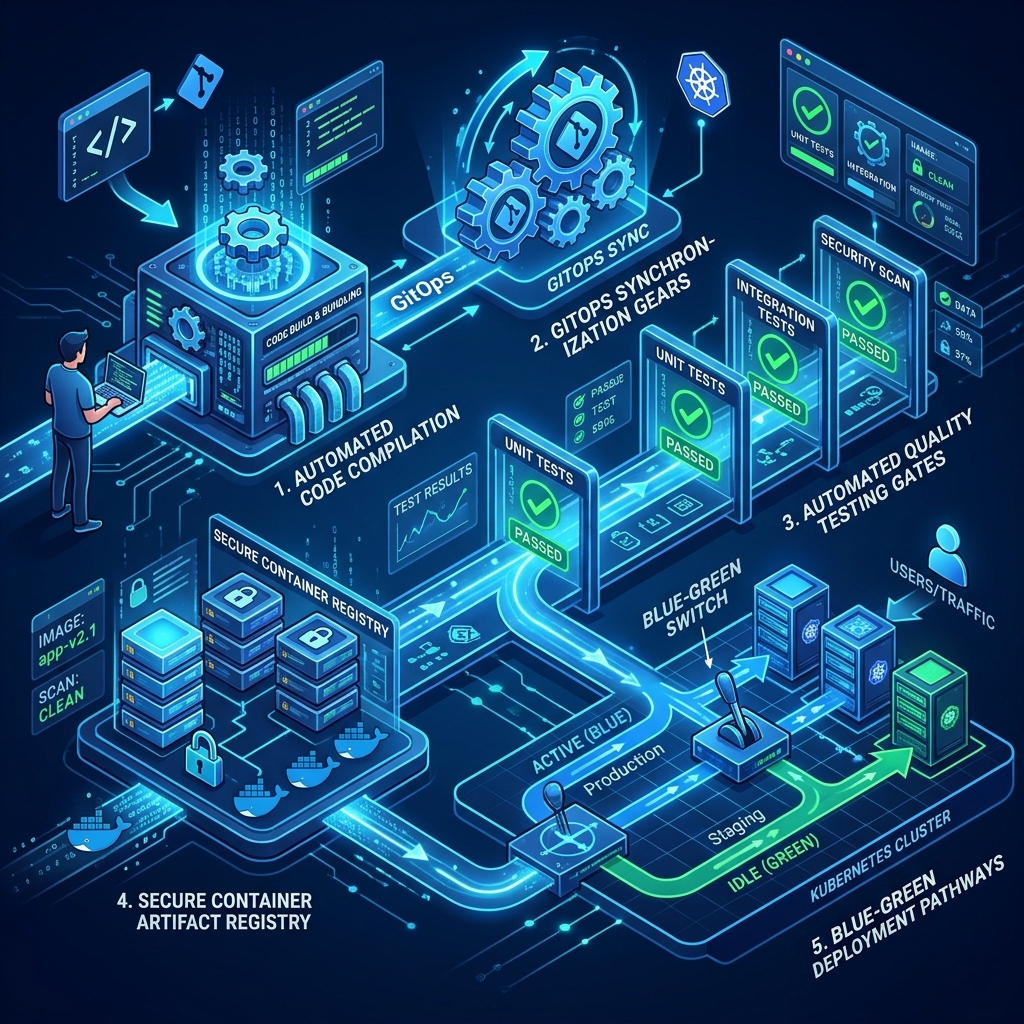
Select a use case to view its scenario, outcome and delivery steps.
Guarantee continuous service availability utilizing multi-region control planes, automated node recovery routines, and resilient pod topologies across production clusters.
Minor version upgrades frequently cause breaking API changes, configuration drift, and application downtime.
Containerize legacy workloads into optimized Docker containers, decoupling monolithic systems into secure, lightweight microservices ready for cloud deployment.
Guarantee continuous service availability utilizing multi-region control planes, automated node recovery routines, and resilient pod topologies across production clusters.
Comprehensive analysis of legacy codebases, container readiness, network dependencies, and security requirements.
Execute rapid Horizontal and Vertical Pod Autoscaling dynamic responses designed to absorb volatile traffic bursts and real-time workload shifts seamlessly.
Permissive flat pod networking allows lateral movement across namespaces if a single ingress component is compromised.
Architect and maintain production-hardened Kubernetes clusters across EKS, AKS, and GKE featuring dynamic automated node provisioning via Karpenter.
Execute rapid Horizontal and Vertical Pod Autoscaling dynamic responses designed to absorb volatile traffic bursts and real-time workload shifts seamlessly.
Designing secure virtual private clouds (VPCs), custom node groups, identity management integration, and RBAC governance profiles.
Enforce cryptographically signed image verification, real-time threat monitoring, automated vulnerability management, and granular namespace network policies across all clusters.
Static over-provisioned worker nodes running at low average capacity create unnecessary cloud expenditure.
Implement Istio and Cilium service meshes to enable mutual TLS encryption, canary traffic shifting, rate limiting, and distributed tracing.
Enforce cryptographically signed image verification, real-time threat monitoring, automated vulnerability management, and granular namespace network policies across all clusters.
Deploying production clusters using Terraform pipelines alongside essential platform add-ons (Cert-Manager, Ingress, Monitoring stacks).
Delivery approach
We work in clear stages, validate changes with your team, and prepare the workflow for ongoing ownership.
Select a step to explore its activities, buyer inputs and outputs.
Comprehensive analysis of legacy codebases, container readiness, network dependencies, and security requirements.
Designing secure virtual private clouds (VPCs), custom node groups, identity management integration, and RBAC governance profiles.
Deploying production clusters using Terraform pipelines alongside essential platform add-ons (Cert-Manager, Ingress, Monitoring stacks).
Packaging applications into Helm charts, executing seamless cutover migrations, and fine-tuning autoscaling limits.
Configuring automated cluster backups using Velero and transitioning to 24/7 managed monitoring and continuous SRE coverage.
Ownership, guardrails & operations
Good engineering workflows make the paved path easy to use while keeping security, reliability, and ownership visible.
Before delivery starts, we agree which repositories, cloud accounts, clusters, pipelines, and environments are in scope, along with change controls, access needs, and the teams responsible for ongoing operations.
Make common engineering tasks easier to start and repeat.
Build review, access, and policy checks into the workflow.
Keep service owners, support paths, and follow-up work clear.
Engineering readiness checklist
Use these checks to prepare your team, repositories, environments, and delivery goals for a focused engineering review.
Common questions
Clear answers to help your team plan the right next step.
Absolutely. While self-managing Kubernetes creates steep learning curves, leveraging cloud-managed offerings (such as EKS or GKE) alongside SNWN's managed SRE services eliminates administrative overhead. This grants growing organizations enterprise-grade resilience, automated scaling, and cost efficiency without needing to staff dedicated, in-house platform engineering teams.
Modern Kubernetes supports stateful applications seamlessly through the Container Storage Interface (CSI) and StatefulSets. However, depending on performance and operational needs, we often recommend a hybrid pattern: running stateless application microservices on Kubernetes while pairing them with managed cloud database services (such as AWS RDS or GCP Cloud SQL) to achieve optimal uptime and simplified disaster recovery.
Karpenter evaluates pending pod requirements directly and dynamically provisions the optimal mix of compute instance types, sizes, and Spot pricing within seconds without relying on rigid static node groups. This drastically reduces cloud compute expenditure by up to 50% while improving provisioning speed.
We implement multi-layered Kubernetes security including automated image vulnerability scanning, cryptographic signature verification (Cosign), Pod Security Standards (PSS), Open Policy Agent (OPA) admission controllers, and real-time runtime monitoring with Falco.